Why the Next Generation of Substation Protection Needs to Rethink the Wall
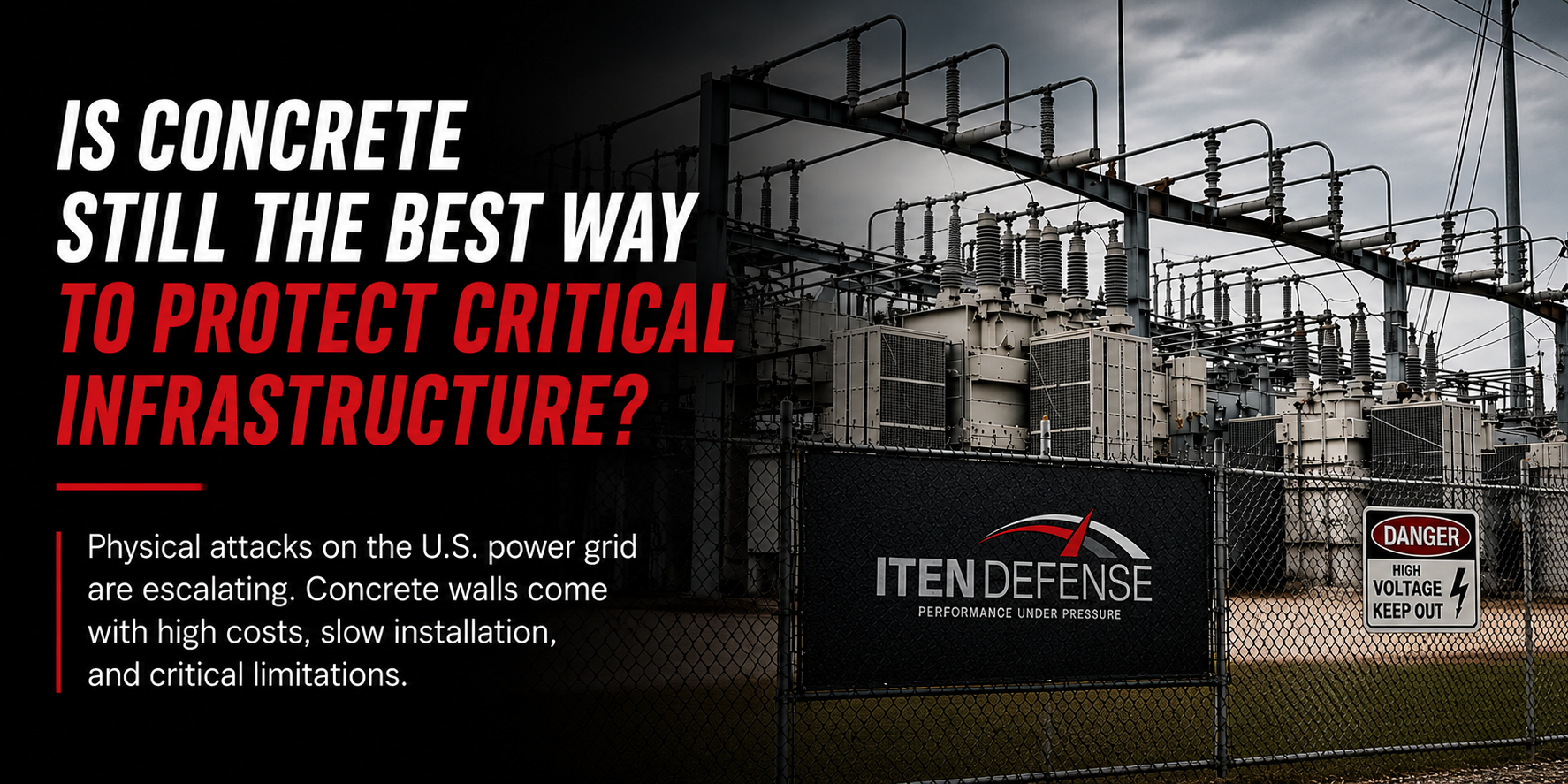
Physical attacks on the U.S. power grid are no longer theoretical. They are escalating, and the industry's default response, building concrete walls, is becoming harder to justify on either security or cost grounds.
Ballistic threats to utility infrastructure now come from multiple directions: opportunistic vandalism, organized criminal activity, and coordinated attacks aimed squarely at the nation's critical energy systems. Whatever the source, the result is the same, damaged transformers, interrupted service, and a growing recognition that the industry needs a more flexible, cost-effective answer.
A Threat That Keeps Growing
The scale of the problem has become impossible to ignore. Reported physical attacks on grid infrastructure have risen sharply over recent years, with high-powered rifles emerging as the weapon of choice. The attraction for attackers is straightforward: a rifle allows damage from a safe distance, often in darkness, at a substation that may sit miles from the nearest population center. By the time anyone responds, the equipment is already destroyed.
The 2013 attack on Pacific Gas & Electric's Metcalf transmission substation in California became a turning point in how utilities think about physical security. Gunmen fired over 100 rounds into cooling systems, causing $15 million in damage. The station narrowly avoided a regional blackout. More than a decade later, Metcalf has become shorthand in the security industry for what happens when ballistic threats go unmitigated, and utilities have been on alert ever since.
The regulatory framework caught up in 2014, when the Department of Homeland Security directed utilities to comply with NERC's Critical Infrastructure Protection standard CIP-014. The standard requires utilities to identify their most critical transmission substations, conduct independent risk assessments, and implement physical security measures commensurate with the threat. For many utilities, CIP-014 compliance marked the first time ballistic protection was formally on the table.
The Concrete Response — and Its Limits
The most common initial response to CIP-014 requirements was also the most intuitive: build a wall. Across the country, utilities moved to erect concrete perimeter barriers around hundreds of substations. It was a logical first step, concrete is familiar, available, and conveys a sense of permanence.
But concrete perimeter walls come with serious operational and security limitations that have become increasingly apparent.
First, they do not address elevated threats. A rifle fired from a hillside, an overpass, or an adjacent structure can clear a perimeter wall entirely and strike the equipment it was meant to protect. A wall that stops a ground-level attacker provides no meaningful protection against anyone with height advantage, a vulnerability that sophisticated actors actively exploit.
Second, concrete construction is slow. A full perimeter hardening project can take weeks to complete, leaving the substation exposed during the installation window, ironically, a period when it may be more visible and more vulnerable than before construction began.
Third, cost. For a mid-sized substation, a fully installed ballistic-rated concrete perimeter can run into the millions of dollars, and in some cases, substantially more when site preparation, footings, and ancillary security infrastructure are included. For utilities managing dozens of CIP-014-qualifying assets, that cost scales rapidly.
Rethinking the Specification: Do You Need Level 10?
When utilities began specifying ballistic protection in earnest, many defaulted to the highest available ratings, UL Level 10, capable of stopping .30 caliber armor-piercing ammunition. The instinct is understandable: if you're hardening a critical grid asset, go as far as the spec allows.
In practice, most threat profiles don't warrant it. The vast majority of documented attacks on utility infrastructure have involved common rifle calibers, .308 Winchester, 5.56mm, and similar rounds that fall within the UL Level 3 to Level 8 range. UL Level 3 provides protection against handgun threats including .44 Magnum; Level 8 stops 7.62mm NATO rifle rounds. For the overwhelming majority of real-world threat scenarios, including the Metcalf-style attack that defined the category, a Level 8 solution provides robust, meaningful protection.
The practical implication: by right-sizing the ballistic specification to the actual threat, utilities can access significantly more cost-effective solutions without compromising on security outcomes that matter. Level 10 protection at significant cost premium makes sense for certain high-value, high-consequence assets. For the broader population of CIP-014 qualifying substations, Levels 3 through 8 represent a more defensible and affordable standard.
A Smarter Approach: Harden the Fence, Protect the Asset
If the concrete wall is no longer the right answer, what is? Industry thinking is converging on two complementary strategies.
The first is perimeter upgrade rather than perimeter replacement. Most substations already have a chain-link fence. Rather than demolishing it and staging a weeks-long concrete construction project, modular ballistic panel systems can be retrofitted to existing fence infrastructure, providing rated ballistic protection in a fraction of the time, with a fraction of the construction footprint. Critically, a panel-based system can be deployed and removed quickly, adapting to changing threat environments without a major capital project each time.
The second, and arguably more cost-effective, strategy is asset-level protection. A substation's perimeter may encompass thousands of square feet, but the equipment that actually needs to survive a ballistic attack is a much smaller surface area: the high-voltage transformer, associated radiators, control cabinets, and switchgear. Armoring these specific assets directly, rather than walling off the entire site, can reduce the protected surface area by an order of magnitude. For utilities operating under budget pressure, asset-level protection may be the clearest path to meaningful risk reduction at a manageable cost.
What the Market Is Saying
Conversations with utility security professionals and perimeter protection companies at recent industry events confirm that demand for ballistic solutions is real and widespread. The consistent feedback is not a lack of interest, it is a lack of a standardized, deployable product. What utilities and their integrators are asking for is a kit: a defined, tested, installable solution that can be specified, procured, and deployed without a custom engineering engagement at each site.
Cost is emerging as an equally important driver. A UL Level 3 modular panel system deployed across a full substation perimeter can arrive at a comparable total material cost to a conventional concrete wall installation, while requiring a fraction of the installation time and none of the heavy construction equipment. For a utility that needs protection in place quickly, or that is managing multiple sites simultaneously, that equation is increasingly difficult to ignore.
That represents a significant market gap, and a significant opportunity for manufacturers and channel partners who can deliver a repeatable, tested solution at scale.
INDUSTRY OBSERVATION
Iten Defense, a U.S. manufacturer of NIJ and UL 752-tested ballistic panels, offers both fiberglass and ultra-high-molecular-weight polyethylene (UHMWPE) solutions, both capable of meeting the same protection standards, with polyethylene delivering the lightest weight option at roughly 3 to 5 lbs per square foot. Our go-to-market model works through perimeter security integrators and OEM partners rather than direct to utilities, positioning Iten as the behind-the-scenes supplier that helps channel partners offer a tested, deployable ballistic upgrade without the weight, cost, or construction timeline of conventional concrete systems. For an industry searching for that repeatable, installable kit, it is a model worth watching.
This article reflects publicly available information and industry observations. It does not constitute investment or procurement advice.
For sales, inquiries more details on structure protection solutions, please contact: Matthew Borowiak mborowiak@itendefense.com